Established in 2005 under the name Norwegian Offshore Drilling Engineering, NODE organized the supplier industry in Agder, which was a highly competent and growing value chain for offshore drilling equipment. At its peak in 2014, the cluster companies employed close to 10,000 people. A ripple effects analysis concluded that NODE companies created 15,000 jobs in Norway and 30,000 jobs internationally.
“Organizing the industry which has had the most impact on our region, comes with a great responsibility. NODE has played an important role in bringing major and minor companies together. By fostering innovation and cooperation within the cluster, NODE has contributed to increased innovation, competitiveness, and value creation,” says Knut Mjåland, CEO of GCE NODE.
A LEADING NORWEGIAN CLUSTER
Entering the Norwegian Cluster Program at the Arena level in 2006, NODE was quickly promoted to a National Center of Expertise in 2009, before achieving the highest level – Global Center of Expertise – in 2014. At that point, NODE comprised the three leading offshore drilling majors in Kristiansand, which combined had approximately 80 per cent of the global market.
The GCE period, which is now coming to an end, saw strong national funding for research, development and innovation, and business development of the cluster participants.
NODE ART
One of the first milestones in the cluster’s innovation history was the NODE ART project, which came about before the GCE period. Designed to solve the industry problem of corrosion on offshore installations, NODE ART was a huge success, and an example of how fierce competitors can come together to solve common problems for the benefit of all.
SFI OFFSHORE MECHATRONICS
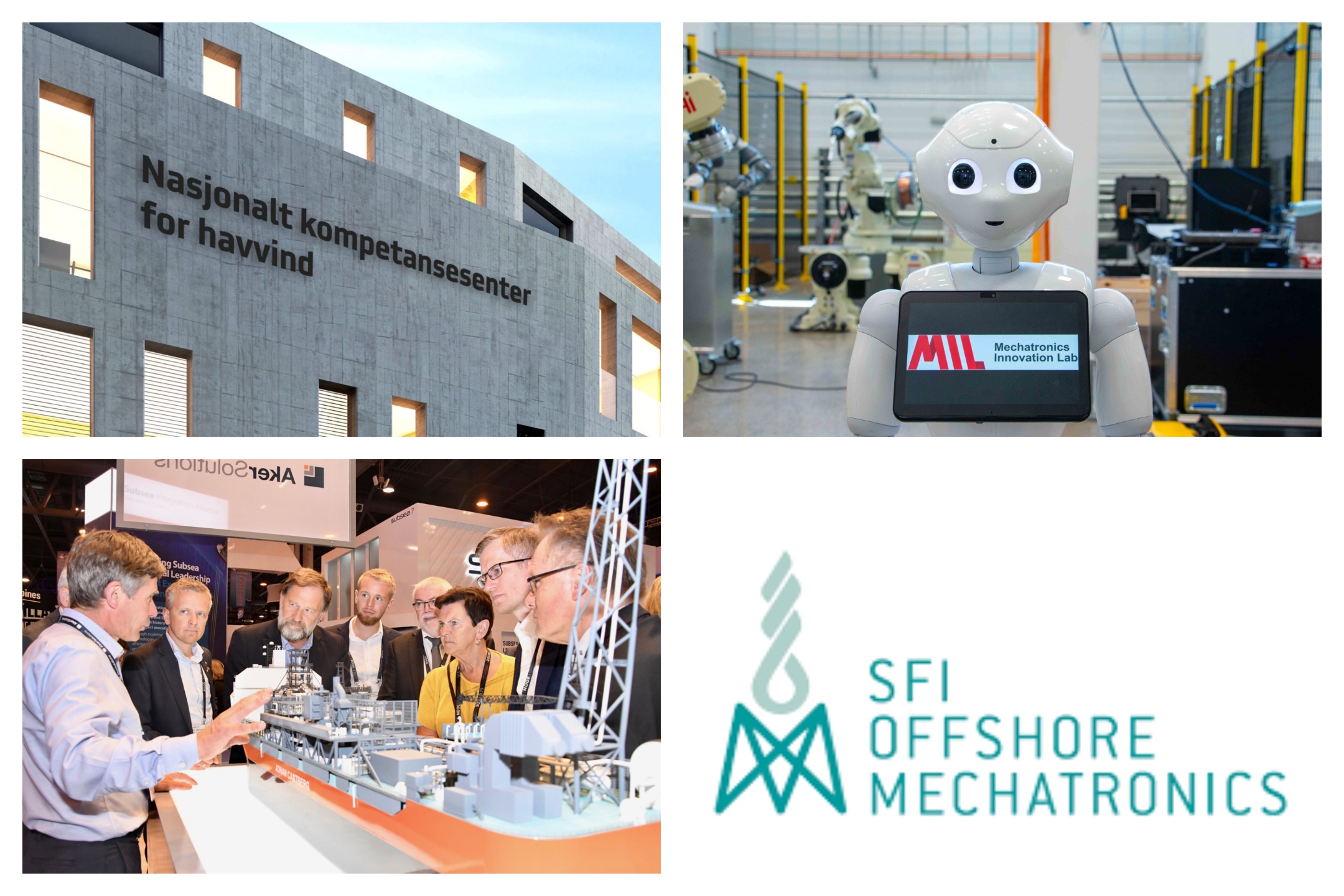
Earning the GCE status in 2014 was an achievement in itself but it also attracted more interest in NODE and funding for new cluster projects. In 2015, GCE NODE was part of a University of Agder led consortium that was awarded a Center for Research-driven Innovation in Offshore Mechatronics. This eight year program developed offshore drilling systems through autonomous operations and condition monitoring. GCE NODE managed Work Package 7: Technology Vision, creating an arena for exploring future trends and strategic adjustments. The center united industry giants, producing research that shaped offshore automation.
MIL: A PLAYGROUND FOR INNOVATION
Also in 2015, GCE NODE was instrumental in securing industry support and public funding for Mechatronics Innovation Lab (MIL) in Grimstad. Bridging research and industry, this state of the art facility opened in 2017 and quickly became a testbed for robotics, automation, and other technologies. It empowered companies to prototype, test, and validate solutions before deployment, accelerating innovation and reducing risk and time-to-market.
As a result of the downturn in the oil and gas industry and the emerging focus on renewable energy in the ocean space, GCE NODE and its cluster companies found increasing interest for offshore wind.
“The mandate and strategy of GCE NODE shifted to include new ocean technologies, acknowledging that the ocean space is our natural arena,” explains Mjåland.
NATIONAL COMPETENCE CENTER FOR OFFSHORE WIND
GCE NODE became a strong advocate for the creation of the National Competence Center for Offshore Wind, which was established in 2023. Positioning Southern Norway as a hub for offshore wind expertise, the center fosters collaboration between academia, industry, and government, ensuring Norway remains competitive in the global energy transition.
Spanning 20 years, GCE NODE’s history is one of innovation and collaboration to the benefit of companies and the region in which they operate.
“As we enter 2026, GCE NODE turns the page to write a new chapter. The central narrative remains unchanged: World-leading companies with world-leading competence and technology, driven by a desire to innovate and operate on the global stage,” says Mjåland.